Too Wired to Wind Down? Yoga Has a Fix That Isn't Sitting Still and Breathing
You open a meditation app, close your eyes, and within forty-five seconds you're mentally rewriting an email from last Tuesday. Sound familiar? For a huge chunk of high-functioning, chronically overstimulated Americans, "just meditate" is about as useful as telling someone with a broken leg to "just walk it off."
Here's what nobody tells you: traditional yoga was never designed to start with the mind. It was designed to work through the body first — because the ancient practitioners who built this system understood something neuroscience is only now catching up to. When your nervous system is running too hot, willpower alone won't cool it down. You need a physical lever.
What "Overstimulated" Actually Means in Your Body
Think about a typical Tuesday. You wake up to a phone already buzzing with notifications. Your commute — whether you're stuck on I-95 or crammed into a subway car — is a sensory assault. Your open-plan office hums with ambient noise. You eat lunch while scrolling. By 4 PM, your shoulders are somewhere near your earlobes and you have no idea why you feel simultaneously exhausted and completely unable to relax.
In Ayurvedic terms, this is classic Vata aggravation — specifically, an excess of the mobile, light, and erratic qualities that govern the nervous system. But forget the Sanskrit for a second. What this really means is that your body's threat-detection system, the sympathetic nervous system, has been running a low-grade alarm all day. It's not dramatic. You're not in crisis. You're just... perpetually on.
The problem with chronic low-level activation is that it raises your baseline. Your nervous system starts to treat "loud" as normal. And when that happens, the gap between where you are and where you need to be to actually rest becomes enormous. Sitting quietly and trying to think calming thoughts doesn't bridge that gap — it just highlights it.
Why Your Body Needs a Physical Volume Knob
Yoga's classical framework — the one that predates the modern studio version by several thousand years — addresses this with something called pratyahara, or sensory withdrawal. It's one of the eight limbs of yoga, and it's specifically designed to come before meditation, not after. The ancients weren't naive. They knew you couldn't just decide to tune out the world. You had to create the physiological conditions that made tuning out possible.
Pratyahara isn't about plugging your ears and closing your eyes. It's about using the body to actively redirect the nervous system's attention inward. And it works through three main channels: specific postures (asana), hand gestures (mudras), and the deliberate withdrawal of sensory input through movement and breath coordination.
Think of it less like meditation and more like slowly turning down a stereo that's been blasting all day.
The Asanas That Actually Regulate, Not Just Relax
Not all yoga poses are created equal when it comes to nervous system regulation. The ones that tend to work best for chronically activated people aren't the ones that look the most peaceful — they're the ones that give the body something specific to do.
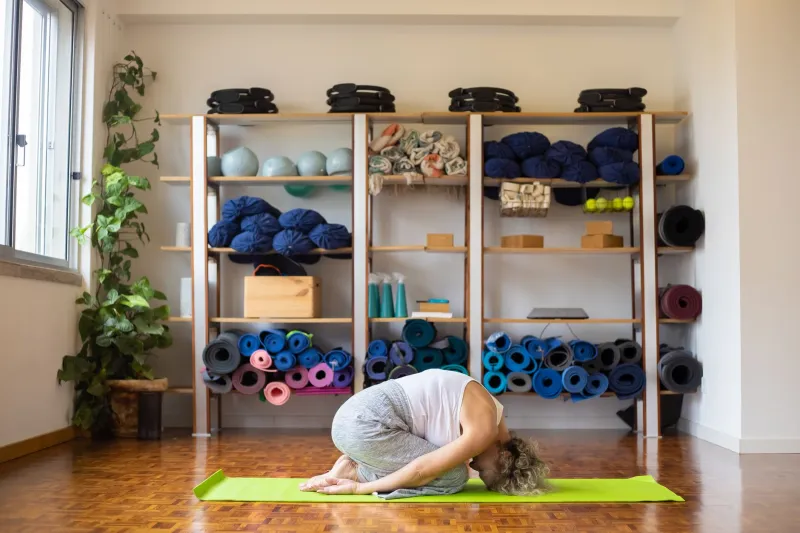
Supported forward folds — like a seated forward bend with a bolster or folded blanket under your forehead — activate the parasympathetic nervous system through vagal stimulation. The pressure on the forehead is key. It's not accidental that this position shows up in so many contemplative traditions. Your body reads it as a signal to downshift.
Legs-up-the-wall (Viparita Karani) is arguably one of the most underrated tools in the entire yoga toolkit for overstimulated professionals. Reversing the blood flow from your lower body, combined with the passive nature of the pose, creates a measurable drop in cortisol over time. It requires almost no flexibility and zero mental discipline. You just lie there.
Slow, weighted Cat-Cow with an emphasis on the exhale gives the overactive mind something rhythmic and physical to track. The rocking motion has a neurologically regulating effect — it's the same reason humans instinctively rock when distressed. You're not suppressing the nervous system; you're giving it a gentler rhythm to sync to.
Mudras: The Part of Yoga Most People Skip
If you've ever dismissed mudras as too esoteric, it might be time to revisit that call. Hand gestures in yoga aren't decorative. They work through a combination of acupressure points in the fingers and the cognitive anchoring effect of physical ritual — both of which have real implications for nervous system state.
Apana Vayu Mudra — where the index finger folds to the base of the thumb while the middle and ring fingers touch the thumb tip — is traditionally associated with grounding and downward-moving energy. In practical terms, holding this mudra during even five minutes of seated stillness gives the fidgety, high-strung body something to hold, which makes stillness far more accessible.
Shanmukhi Mudra, or the six-gate seal, involves gently closing the eyes, ears, nostrils, and mouth with the fingers. It sounds intense but it's remarkably effective for people who feel like their senses are constantly being hijacked. You're not meditating. You're literally creating a quieter sensory environment from the inside out. Even two minutes of this can feel like stepping out of a crowded bar into a cool, quiet street.
The Exhale Is the Lever
If there's one non-negotiable in all of this, it's the exhale. Specifically, making your exhale longer than your inhale. This isn't a metaphor or a vibe — it's physiology. The exhale activates the vagus nerve, which is the primary pathway of the parasympathetic nervous system. A 4-count inhale paired with a 6 or 8-count exhale is one of the fastest, most evidence-backed ways to shift your autonomic state.
Yoga called this Vishama Vritti pranayama. Modern researchers call it heart rate variability training. Either way, the mechanism is the same: you're using the breath as a direct line to your nervous system's off switch.
The difference between this and generic "deep breathing" advice is intention and ratio. Slow, even breathing without the extended exhale doesn't have the same regulatory effect. The length matters. The deliberateness matters.
Building a Practice for the Wired Brain
If you're someone who's tried meditation and hit a wall, try reframing your approach entirely. Instead of starting with stillness, start with movement. Do ten minutes of slow, exhale-focused Cat-Cow or a few rounds of Sun Salutations paced to your breath. Then transition into a supported forward fold or Legs-up-the-wall for five to ten minutes. Add a mudra if you want something for your hands. Then try sitting quietly.
You're not cheating. You're doing it in the right order.
The ancient yoga tradition understood that the body is the gateway to the mind — not the other way around. For the chronically overstimulated, that sequence isn't just philosophically sound. It's the only thing that actually works.
Your nervous system has been running loud for a long time. The volume knob is real. You just have to reach it through your body first.