Stretching More But Moving Worse? Your Body Might Be Begging for Strength Instead
There's a quiet frustration that lives inside a lot of yoga practitioners — especially those who've been at it for a year or two. You're consistent. You show up. You breathe through the discomfort. And yet your hamstrings still feel like guitar strings, your hips still catch when you walk up stairs, and that deep hip opener you've been chasing forever still feels completely out of reach.
Here's what nobody in your Sunday flow class is saying out loud: more stretching might literally be the wrong answer.
Not because yoga doesn't work. It does. But because a huge slice of modern American yoga culture has quietly collapsed into one mode — passive, long-hold, "just breathe and sink deeper" stretching — and that approach, done in isolation, can actually stall your progress and destabilize the very joints you're trying to free up.
Ayurveda and traditional yoga have always understood something that Western fitness is only now starting to rediscover: the body doesn't separate flexibility from strength. They're two sides of the same coin. Ignore one, and the other eventually breaks down.
The Western Yoga Flexibility Trap
Walk into most yoga studios in the US and you'll find a culture built around deepening poses — longer holds, more props, more release. There's real value in that. Parasympathetic nervous system activation, fascial hydration, breath awareness — these are legitimate benefits of slower, passive practice.
But somewhere along the way, depth became the goal. The deeper the forward fold, the better the practitioner. The more open the hips, the more "advanced" the body. This framing quietly trains people to override their body's protective signals and chase a shape rather than a function.
The problem? Your nervous system is smarter than your ambition. When a joint is pushed into a range it can't actively control — meaning your muscles can't actually hold you there without gravity or your own body weight doing the work — your body flags it as unstable territory. Over time, it responds by tightening up around that joint to protect it. Which means the more you passively stretch without building the strength to support that range, the more your body quietly pulls back the other direction.
This is one of the most common reasons people hit a flexibility plateau. They're not inflexible. They're unprotected.
What Ayurveda Sees That Your Stretch Class Doesn't
Ayurveda approaches the body through the lens of balance — specifically, the balance of the three doshas and the interplay of opposing qualities. Sthira and sukha. Stability and ease. These aren't just philosophical concepts; they're practical design principles for how a healthy body should move.
In Ayurvedic terms, a body that's all ease and no stability is in a Vata-aggravated state. Vata governs movement, space, and air — and when it's out of balance, tissues become dry, joints become lax, and the nervous system becomes hypersensitive. Sound familiar? If you've been doing a lot of passive, yin-style practice and you're noticing more joint clicking, more fatigue after class, or a kind of achy looseness that doesn't feel like progress — that's a Vata signal worth paying attention to.
Traditional yoga, rooted in this same understanding, was never just about stretching. Classical hatha practice was designed to build tapas — internal heat and disciplined effort — alongside the more receptive qualities of surrender and release. Strength poses weren't the warm-up before the real work. They were the point.
How to Know If Your Body Needs Resistance, Not Release
You don't need a dosha quiz to figure out whether your practice is imbalanced. Your body is already telling you. A few signs that you've tipped too far into passive territory:
- Your flexibility gains feel temporary. You open up in class and feel stiff again by morning.
- Your joints feel loose or unstable rather than spacious and free.
- You're more tired after yoga than energized. Deep parasympathetic dips without muscular engagement can leave the body depleted.
- Your posture is getting worse, not better. Hypermobility without supporting strength shows up as slumping, forward head carriage, or collapsing arches.
- You keep getting the same nagging injuries — usually in the SI joint, lower back, knees, or shoulders.
None of these mean yoga isn't for you. They mean your practice needs more sthira — more stability, more active engagement, more strength work woven into the same session.
Rebalancing Your Practice: Practical Starting Points
Add active range of motion work. Instead of holding a passive hamstring stretch for two minutes, try slowly lifting your leg from a supine position without any assist and holding it at your end range for a few breaths. This trains your muscles to own that range rather than just borrow it from gravity.
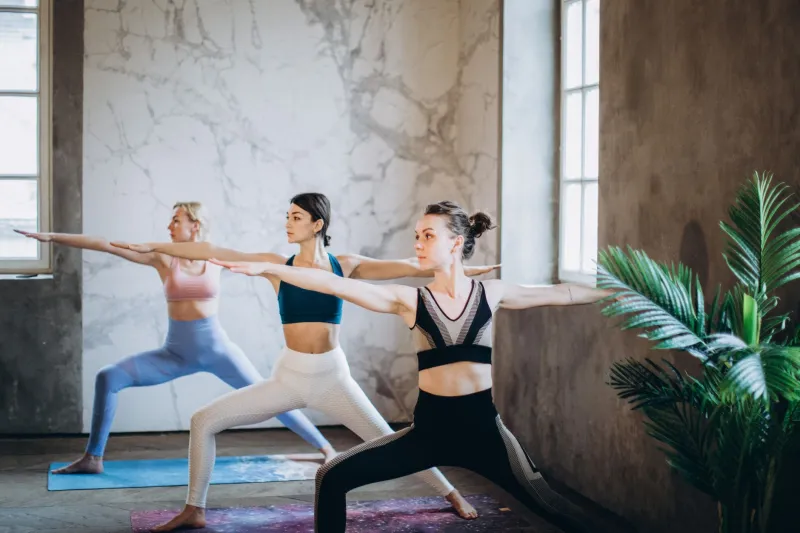
Explore isometric holds in standing poses. Warrior I and II aren't just about alignment — they're strength builders when you actually engage the legs fully and resist the urge to sink passively into the hip. Press the back foot down. Firm the thighs. Let the pose work you.
Try eccentric loading. Slowly lowering into a pose — rather than dropping into it — recruits muscle fibers in a way that passive holding never does. Lower into Malasana (squat) over eight slow counts. You'll feel the difference immediately.
Balance every deep hip opener with a hip stabilizer. For every long pigeon pose, add a single-leg glute bridge or a slow lateral leg raise. The hip flexors and external rotators need opening; the glutes and deep hip stabilizers need strengthening. You need both.
Revisit pranayama as a grounding tool. If your practice is Vata-heavy — lots of flowing movement, lots of passive release — Nadi Shodhana (alternate nostril breathing) or a slow, counted exhale practice can help settle the nervous system into a more stable baseline before you move.
The Long Game
Mobility isn't the same thing as flexibility. Mobility is the ability to move through a range with control — which means your muscles are doing the work, not just your ligaments and gravity. That's the kind of movement that ages well. That's what keeps you picking things up off the floor at 70 without thinking about it.
Ayurveda has always known that health isn't about maximizing any one quality — it's about balance between opposites. Strength and softness. Effort and ease. The bindu — the point of integration — is where both meet.
If your yoga practice has been living too far on one side of that spectrum, the plateau you're hitting isn't a failure. It's information. Your body isn't asking you to stretch harder. It's asking you to hold on.
Listen to it.