No Mat Required: Ancient Indian Movement Practices That Fix What Sitting All Day Breaks
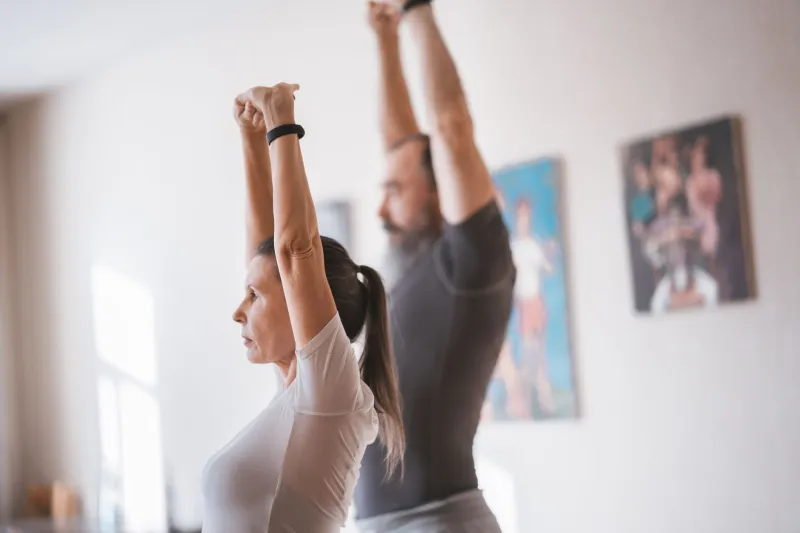
Let's be honest about something. Most of us aren't making it to a yoga class three times a week. We're sitting in an office chair for eight-plus hours, eating lunch at our desks, and then wondering why our hips feel like they're made of concrete by Thursday afternoon.
Yoga gets a lot of well-deserved attention in the Western wellness space, but it's not the only movement tradition India developed. There's a whole ecosystem of body practices — some thousands of years old — that were designed for functional human movement, not just flexibility or spirituality. And several of them are remarkably well-suited to the specific problems that sedentary, screen-heavy American work culture creates.
Here's a practical guide to five of them.
1. Kalaripayattu-Inspired Joint Rotations: Your Morning Tune-Up
Kalaripayattu is one of the world's oldest martial arts, originating in Kerala, India. Before practitioners ever pick up a weapon or spar with a partner, they spend significant time on meyppayattu — body conditioning sequences that emphasize fluid joint mobility, spinal articulation, and coordinated breath-movement patterns.
You don't need to train as a martial artist to borrow the warm-up. The fundamental joint rotation sequence (sometimes called angasadhana) moves through the body systematically — ankles, knees, hips, wrists, elbows, shoulders, neck — in circular, multi-directional patterns that most gym-based warm-ups completely ignore.
Try this: Each morning before you open your laptop, spend 5–7 minutes doing 10 slow, controlled circles at each major joint. Go both directions. Focus on the end range — the places where movement feels stiff or sticky. These aren't ballistic stretches; they're controlled explorations of your available range.
The goal isn't flexibility. It's synovial fluid circulation — keeping the joints lubricated so that hours of static loading don't compound into chronic stiffness. Kalaripayattu masters understood this intuitively. Sports medicine researchers have since confirmed the mechanism.
2. Abhyanga for the Desk Worker: Self-Massage as Recovery Tool
Abhyanga — warm oil self-massage — is one of Ayurveda's foundational daily practices (dinacharya). In classical texts, it's recommended as a daily ritual for longevity, nervous system regulation, and joint health. The Charaka Samhita, one of Ayurveda's core texts, specifically notes that regular abhyanga prevents stiffness, fatigue, and deterioration of the tissues.
For someone who sits for a living, the most valuable version of abhyanga isn't a full-body ritual (though that's great on weekends). It's a targeted 5-minute sequence focused on the areas that bear the brunt of desk work:
- Forearms and wrists: Use your opposite thumb to work along the forearm muscles toward the elbow. Circular pressure around the wrist joint. This is especially valuable if you type a lot.
- Neck and base of skull: Warm a small amount of sesame or coconut oil in your palms. Work up the back of the neck with firm upward strokes, then small circles at the base of the skull (occiput). Tension headaches often originate here.
- Feet: Before bed, a few minutes of foot massage with sesame oil does double duty — it's deeply grounding (Ayurveda connects foot massage to calming the nervous system via the marma points concentrated there) and genuinely helps with plantar fascia health.
The oil matters. Sesame oil is warming and deeply penetrating — good for vata types or anyone in a cold climate. Coconut oil is cooling — better for pitta types or summer use. If you're not sure, sesame is the Ayurvedic default.
3. Sukshma Vyayama: The Micro-Movement System You've Never Heard Of
Sukshma Vyayama translates roughly to "subtle exercise" and refers to a system of gentle joint and energy-channel movements developed within the broader yoga tradition. Unlike the asana practice most Americans know, Sukshma Vyayama is done seated or standing, requires no mat, and takes about 10 minutes.
It's specifically designed to move prana (life force) through areas that become stagnant — which is exactly what prolonged sitting does. The sequences include:
- Eye rotations (yes, your eyes have muscles that need movement too — staring at a screen locks them into a fixed focal range)
- Jaw circles and gentle jaw opening (the jaw holds an enormous amount of stress and is almost never intentionally mobilized)
- Finger spreads and fist sequences to counteract the claw-like tension that builds from keyboard use
- Ankle alphabet — tracing the letters of the alphabet with your toes while seated, which activates the small stabilizing muscles of the ankle that go dormant during prolonged sitting
This is legitimately something you can do at your desk. No one needs to know what you're doing with your ankles under the conference table.
4. Squat Culture: Reclaiming the Position Your Body Was Built For
The deep squat — malasana in yoga, but more fundamentally just a basic human resting position — is something most American adults have completely lost access to. In India, as in much of Asia, squatting is a default resting position, used while waiting, eating, and working. The result is lifelong hip, ankle, and lumbar mobility that Western chair culture systematically eliminates.
Reclaiming your squat doesn't require a yoga class. It requires about 3 minutes a day of deliberate practice:
- Stand with feet slightly wider than hip-width, toes turned out slightly
- Lower yourself as far as you comfortably can, holding onto a doorframe or desk edge if needed
- Work toward holding the bottom position for 30–60 seconds
- Focus on keeping your heels on the floor — this is where most people struggle initially
Over 4–6 weeks of daily practice, most people see significant improvement. The payoff is substantial: reduced lower back pain, better hip flexor length, improved ankle mobility, and a more functional movement base for everything else you do.
5. Trataka for Your Overworked Eyes and Overstimulated Brain
This one is less about physical mobility and more about the sensory overload that compounds physical tension. Trataka is a classical yoga practice involving steady, unblinking gaze at a fixed point — traditionally a candle flame. In the context of screen fatigue, it functions as both an eye exercise and a focused attention reset.
A screen-friendly version: Every 90 minutes, set a timer for 3 minutes. Look out a window at something at least 20 feet away (this is actually validated by optometrists as the "20-20-20" rule — every 20 minutes, look 20 feet away for 20 seconds). Then soften your gaze and let your eyes rest without focusing on anything specific. Blink slowly and deliberately.
Trataka, in its classical form, is also understood as a practice that trains dharana — concentration — by giving the scattered mind a single point to return to. After a morning of Slack notifications and context-switching, three minutes of deliberate visual rest is genuinely restorative.
The Through-Line
What connects all of these practices — Kalaripayattu joint work, abhyanga, Sukshma Vyayama, squatting, Trataka — is a philosophy that Indian traditions have held consistently for millennia: the body requires regular, intentional maintenance. Not occasional intense effort, but daily attentiveness to the small things that keep tissue healthy, joints mobile, and the nervous system regulated.
Your desk job isn't going away. But the damage it does isn't inevitable. Five minutes here, three minutes there, a little warm oil before bed — ancient practices, genuinely modern results.