Let's be honest. If you've ever scrolled through yoga content online, you've probably seen it — the perfectly backbent spine, the foot tucked behind the ear, the Instagram-worthy split on a mountaintop at sunrise. And somewhere along the way, a lot of us started believing that that was the goal. That if we could just touch our toes, we'd finally be doing yoga right.
Here's the thing: the ancient teachers would have raised an eyebrow at the whole thing.
Yoga's foundational text, Patanjali's Yoga Sutras, describes the ideal quality of a yoga posture in exactly two words: sthira sukham. Steady and easeful. Rooted and relaxed. That's it. There's no mention of hamstring length. No benchmark for hip rotation. The tradition wasn't chasing flexibility — it was building something far more durable.
How Western Fitness Culture Hijacked the Practice
When yoga made its way into American gyms and studios in the 20th century, it got filtered through a very specific cultural lens — one obsessed with visible, measurable results. A culture that had already turned fitness into performance naturally did the same thing with yoga. Flexibility became the metric because it looks impressive. It photographs well. It signals effort.
But flexibility as a standalone goal is, biomechanically speaking, kind of a trap. Extreme range of motion without corresponding strength and joint stability is actually a liability. Hypermobility — joints moving beyond their natural range — is increasingly recognized by physical therapists as a source of chronic pain and injury, not a sign of health. And yet the modern yoga industry often rewards it.
The irony is that many people drawn to yoga are already hypermobile. They can fold easily, drop into deep backbends without much effort, and get praised for it in class. Meanwhile, their joints are quietly crying out for stability, not more stretch.
What Sthira Sukham Actually Means for Your Practice
Sthira, often translated as "steadiness" or "stability," is the quality that keeps the body safe, grounded, and functional. Think of it as the muscular engagement, the structural integrity, the active intelligence in a pose. It's not rigidity — it's controlled strength.
Sukham — ease or comfort — is its counterpart. It's the breath moving freely, the nervous system calm, the face relaxed even when the pose is challenging. Together, sthira sukham describes a body that's both strong and at peace with itself.
When you reframe your practice around this idea, everything shifts. You stop asking "how deep can I go?" and start asking "am I stable here? Am I breathing? Is this sustainable?"
That reframe alone can transform your relationship with your mat.
The Techniques That Actually Build Resilience
So what does a practice oriented around functional strength and steady ease actually look like? A few things stand out.
Isometric holds over passive stretching. Instead of using gravity and body weight to sink deeper into a pose, try actively engaging the muscles around the joint. In a low lunge, for example, rather than melting into your hip flexor, press your back knee down, firm your front foot into the mat, and draw your inner thighs toward each other. You're creating stability. You're building the muscular support that protects the joint over time.
Breath as the governor. Traditional yoga has always used the breath as a real-time feedback system. If you can't maintain slow, even breathing in a pose, you've gone too far. Full stop. This isn't a weakness — it's the practice working exactly as intended. Your breath is telling you where your genuine edge is, not the edge that looks good in a mirror.
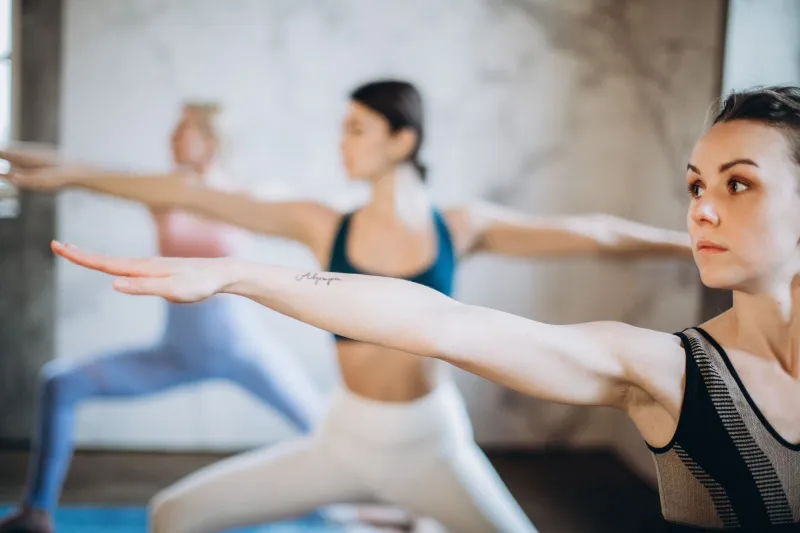
Transitional awareness. Some of the most powerful moments in a yoga sequence happen between poses, not in them. Slowing down your transitions — moving from Warrior II to Triangle with deliberate control, for instance — builds the functional strength that static holds alone can't. It's the difference between a body that can strike a pose and a body that can move through life with ease.
Wall and prop work. Using props isn't a shortcut. It's often the most intelligent choice available. A block under your hand in Triangle Pose allows you to maintain spinal length and hip alignment without collapsing into your flexibility. A wall behind you in Warrior III gives you feedback about where your weight actually is. Props create the conditions for sthira sukham — they don't undermine it.
Ayurvedic Wisdom on Movement and the Body
Ayurveda, yoga's sister science, adds another layer to this conversation. According to Ayurvedic principles, the type of movement your body needs varies based on your constitution — your dosha. Vata types, for example, tend toward natural flexibility and loose joints, but often lack grounding and stability. For them, a practice heavy on deep stretching can actually aggravate their constitution, leaving them feeling anxious, ungrounded, and depleted.
Kapha types, on the other hand, tend to be naturally stronger and more stable but may move through life with less fluidity. Their practice might benefit from more dynamic movement and energizing flows.
The point isn't to rigidly categorize yourself — it's to understand that a one-size-fits-all yoga class doesn't serve everyone equally. Your body has specific needs, and ancient wisdom actually has a framework for figuring out what those are.
Redefining What Progress Looks Like
Progress in a body-intelligence-based practice looks different than progress in a flexibility-focused one. It might look like your Warrior I feeling more grounded than it did six months ago. It might look like recovering from a long run faster because your hips are stable and strong. It might look like less lower back pain, better posture at your desk, or the ability to carry groceries up three flights of stairs without your knees complaining.
None of that makes for a viral post. But all of it is the actual point.
When Patanjali wrote about sthira sukham, he wasn't describing a party trick. He was describing a body that's genuinely well — one that can show up for the demands of daily life with steadiness and ease. That's a much higher bar than touching your toes. And honestly, it's a much more interesting goal to work toward.
So the next time you're in a yoga class and you feel the pull to push deeper into a pose just because you can, try pausing instead. Engage. Breathe. Ask yourself if you're building something real. That's where the ancient practice actually lives — not in the pose, but in the quality of presence you bring to it.