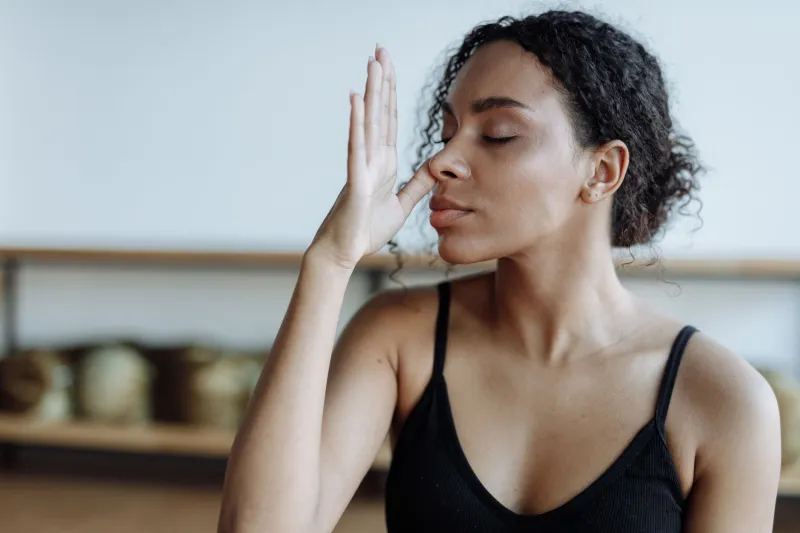
You're in back-to-back Zoom calls, your inbox is a disaster, and somewhere around 3 p.m. you realize your shoulders have been up around your ears for about four hours. Sound familiar? American stress levels have been at or near record highs for several years running, and the go-to solutions — another coffee, a scroll through Instagram, maybe a glass of wine after the kids go to bed — aren't exactly solving the problem.
Here's what's wild: your body already has a built-in, zero-cost, no-prescription-required stress regulation system. It's called your breath. And yogic practitioners figured out how to use it intentionally somewhere around 3,000 years ago.
Pranayama — the formal breathwork tradition within yoga — isn't just deep breathing. It's a precise, evidence-informed system for directly influencing your autonomic nervous system. The techniques below aren't abstract or mystical. They work on measurable physiology. Here's what they are, why they work, and exactly how to use them when life is coming at you fast.
Why Your Breath Is a Direct Line to Your Nervous System
Before diving into the techniques, a quick explainer on the mechanism — because understanding why this works makes you way more likely to actually do it.
Your autonomic nervous system runs two competing programs: the sympathetic (fight-or-flight) and the parasympathetic (rest-and-digest). Chronic stress keeps most of us stuck in sympathetic overdrive — elevated cortisol, shallow chest breathing, heightened alertness, impaired digestion, poor sleep. The whole cascade.
The vagus nerve is the main highway of your parasympathetic system, and here's the crucial part: it's the only part of your autonomic nervous system you can influence voluntarily. And the most direct way to do that is through your breath. Specifically, through the rate, rhythm, and depth of your exhale.
Research from Stanford's Department of Psychiatry published in Cell Reports Medicine in 2023 confirmed what yogis have known for centuries — that certain breathing patterns produce measurable reductions in anxiety, heart rate, and cortisol response, with effects detectable after just a single session. This isn't wellness fluff. It's neuroscience.
Now, let's get into the actual tools.
1. Nadi Shodhana (Alternate Nostril Breathing)
Best for: Pre-meeting anxiety, decision fatigue, scattered focus
Time needed: 5 minutes
Nadi Shodhana translates roughly to "channel cleansing" — the idea being that alternating breath through each nostril balances the two hemispheres of the brain and clears energetic blockages. Modern research offers a compelling parallel: the two nostrils are neurologically connected to opposite brain hemispheres, and alternating between them appears to synchronize left-right brain activity.
How to do it:
- Sit comfortably with a tall spine. Rest your left hand on your knee.
- Bring your right hand to your face: index and middle fingers rest on your forehead, thumb over your right nostril, ring finger over your left.
- Close the right nostril with your thumb and inhale slowly through the left for a count of 4.
- Close both nostrils briefly, then release the right and exhale for a count of 4.
- Inhale through the right for 4 counts, close both, then exhale through the left.
- That's one round. Do 5-10 rounds.
A 2013 study in the Journal of Clinical and Diagnostic Research found that regular Nadi Shodhana practice significantly reduced perceived stress scores and lowered blood pressure in participants after just four weeks of daily practice.
2. Bhramari (Humming Bee Breath)
Best for: Acute anxiety, anger, post-conflict nervous system reset
Time needed: 3-5 minutes
Bhramari involves making a soft humming sound on the exhale — mimicking the sound of a bee. It sounds a little odd until you try it. The vibration created by humming stimulates the vagus nerve directly through the throat and chest, triggering an almost immediate parasympathetic response.
Bonus: the internal vibration also boosts nitric oxide production in the nasal sinuses, which has vasodilating and anti-inflammatory effects. Research published in Integrative Physiological and Behavioral Science found Bhramari significantly reduced heart rate and systolic blood pressure after just six rounds.
How to do it:
- Sit quietly. Gently close your eyes.
- Take a full inhale through the nose.
- On the exhale, make a steady humming sound — mouth closed, lips lightly sealed. Feel the vibration in your skull and chest.
- Keep the exhale long and even. Aim for 6-8 seconds.
- Repeat 6-10 times.
Parents: this one is extremely effective for post-tantrum decompression — yours, not the kid's.
3. Ujjayi (Ocean Breath)
Best for: Sustained stress during long tasks, anxiety during physical activity, shift workers needing a mid-shift reset
Time needed: Can be practiced continuously for minutes at a time
Ujjayi is the breath most people encounter in yoga class — that soft, oceanic sound created by slightly constricting the back of the throat during both inhale and exhale. It's often called "victorious breath," and it's uniquely versatile because you can sustain it during movement, walking, or even seated work.
The throat constriction activates baroreceptors — pressure-sensitive nerve endings in the carotid arteries — that signal the brain to downregulate the sympathetic response. It also naturally slows the breath rate to around 5-6 breaths per minute, which research has identified as the "resonance frequency" for optimal heart rate variability (HRV) — a key marker of stress resilience.
How to do it:
- Breathe in and out through your nose.
- Slightly constrict the back of your throat, as if you're fogging up a mirror, but with your mouth closed.
- You should hear a soft "hhhh" sound on both inhale and exhale.
- Aim for 4-5 second inhales and 6-8 second exhales.
- Sustain for 5-10 minutes, or as long as needed.
4. Box Breathing (Sama Vritti)
Best for: High-pressure moments, pre-presentation nerves, desk workers in crunch mode
Time needed: 4 minutes
Box breathing — known in yogic tradition as Sama Vritti, or "equal fluctuation" — is the technique adopted by Navy SEALs for performance under pressure. That alone should tell you something about its effectiveness. Equal counts on inhale, hold, exhale, and hold create a rhythmic pattern that rapidly stabilizes the autonomic nervous system.
How to do it:
- Inhale for 4 counts.
- Hold for 4 counts.
- Exhale for 4 counts.
- Hold for 4 counts.
- Repeat for 4-6 rounds minimum.
If four counts feels too short, extend to five or six. The ratio matters more than the duration.
5. Extended Exhale Breathing (2:1 Ratio)
Best for: Falling asleep, post-work decompression, anyone who wakes up at 3 a.m. anxious
Time needed: 5-8 minutes
This is the simplest technique on the list and arguably the most powerful for acute stress relief. The science is straightforward: your exhale activates the vagus nerve more strongly than your inhale. Making your exhale twice as long as your inhale tips the autonomic balance decisively toward parasympathetic dominance.
How to do it:
- Inhale through the nose for 4 counts.
- Exhale slowly through the nose (or pursed lips) for 8 counts.
- No holds needed — just the ratio.
- Repeat for 10-15 breaths.
This one works remarkably well in bed when your brain won't stop spinning. It's also a solid tool for shift workers transitioning from a night shift — helping the body signal that it's time to wind down regardless of what the clock says.
Your Quick-Start Protocol
Not sure where to begin? Here's a simple entry point by situation:
- At your desk, mid-stress spiral: Box Breathing, 4 minutes.
- After an argument or tense situation: Bhramari, 5 rounds.
- Before a big meeting or presentation: Nadi Shodhana, 5 minutes.
- Can't fall asleep: Extended Exhale, 10-15 breaths.
- General daily maintenance: Ujjayi, sustained during your morning walk or commute.
You don't need a yoga mat, a studio membership, or a dedicated wellness hour. You just need your breath — and the knowledge of how to use it. That's been available to you all along.